Leash & Dog-Dog Reactivity — Two Faces of Canine Reactivity
About This Series
I’m excited to publish this blog exploring one of the most common—and often misunderstood—behavioral challenges in dogs: reactivity. This article is the first in a three-part series exploring canine reactivity—why it develops, how it manifests, and how science-based interventions can help dogs recover emotional balance. Each installment focuses on a distinct dimension of reactivity while building toward a comprehensive model of canine resilience.
• Article 1 – Leash & Dog-Dog Reactivity: Examines frustration, fear, and miscommunication between dogs, highlighting how leash tension and social pressure can transform ordinary walks into stressful encounters.
• Article 2 – Dog-Human & Dog-Object Reactivity: Expands the discussion to dogs who react toward people, vehicles, or moving objects, exploring perception, early learning, and the role of past experiences.
• Article 3 – The Four Faces of Reactivity: Integrates all forms into a single therapeutic framework—Reactive Resilience Therapy™ (RRT)—that emphasizes emotional recovery, handler regulation, and real-world generalization.
Together, these articles trace the path from reactivity to resilience—showing how understanding a dog’s stress response can help both ends of the leash find calm and confidence.
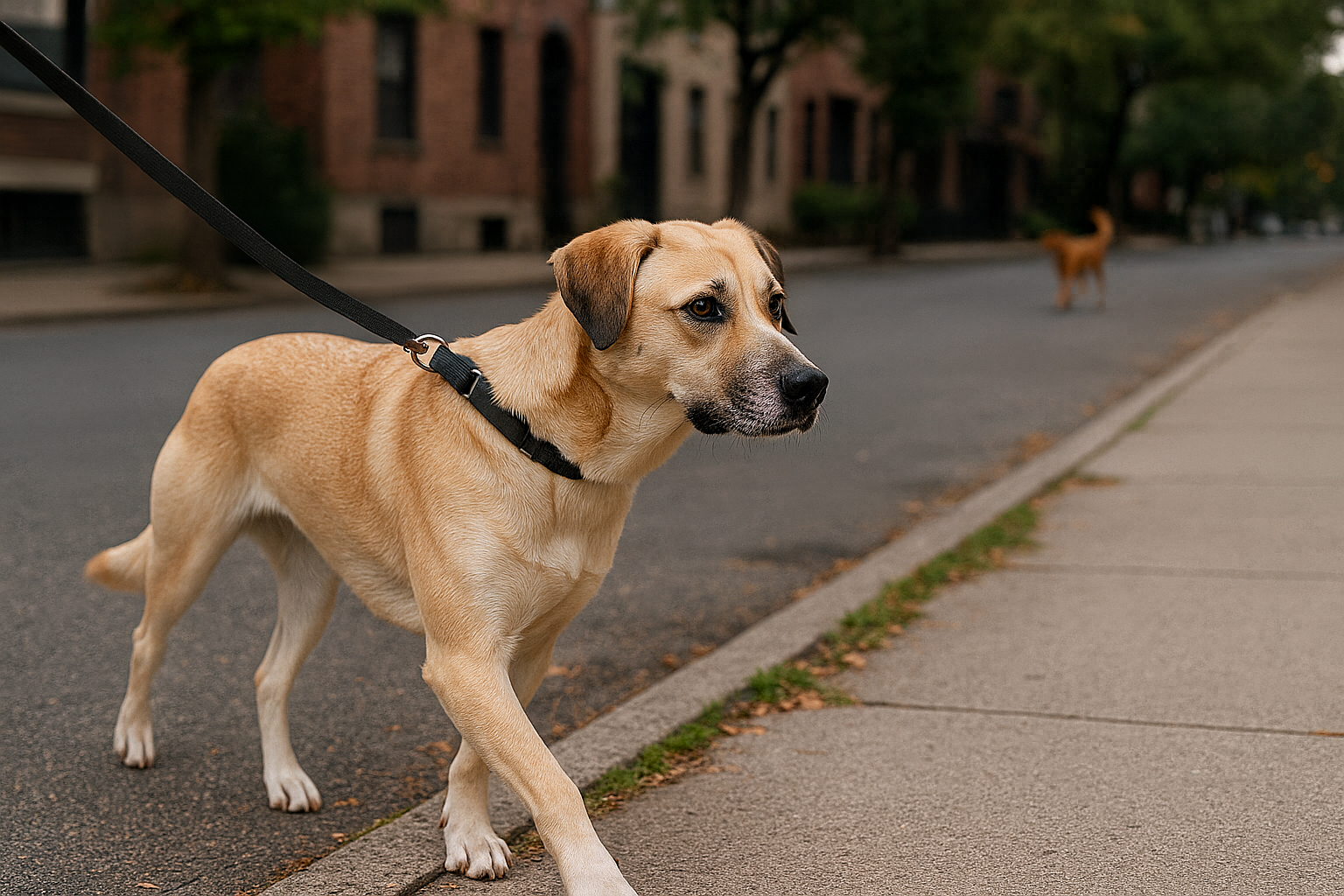
An example of a dog walking calmly despite the presence of another dog (trigger) in the background. Getting your dog to ignore triggers is one of the main therapeutic goals for reactivity.
Quick Summary
Leash and dog-dog reactivity are two of the most common behavior challenges for city dogs. Both stem from the same roots — stress, frustration, and mixed emotional signals between handler and dog. With science-based, positive-reinforcement training and structured exposure, most reactive dogs can learn calmer, more confident ways to cope.
Leash & Dog-Dog Reactivity in NYC Dogs
When it comes to dog reactivity training in NYC, most owners picture a dog barking and lunging at the end of a leash. It’s not defiance — it’s communication. Reactivity isn’t a personality flaw; it’s an emotional response tangled in fear, frustration, and over-excitement. Understanding both leash and dog-dog reactivity sets the stage for progress rather than punishment.
Leash Reactivity
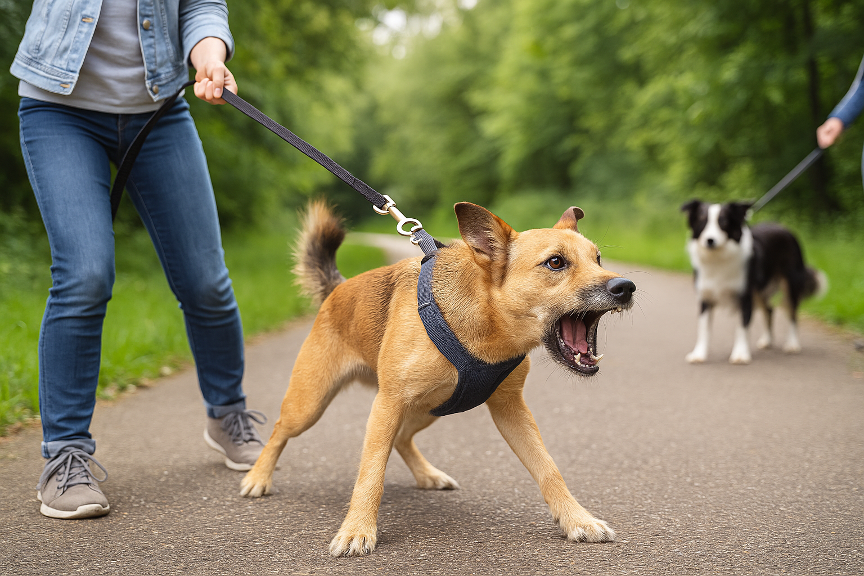
In this scenario the dog on leash is displaying aggressive behavior, barking, showing teeth, ears flattened, tail up, an aggressive stance, and pulling on the leash. Likely frustrated by not being able to interact with the dog in the background.
Leash Reactivity in Action
Imagine walking a dog who transforms from calm companion to Tasmanian devil the moment another dog appears. Leash reactivity happens when restraint amplifies emotion. A dog that might otherwise approach, avoid, or simply observe now finds their options cut off. The leash blocks natural choices, and tension builds—physically and emotionally.
A tight leash even serves as a “danger signal,” raising arousal before the trigger fully appears. From a neuroscience angle, this is the amygdala sounding the alarm while the motor cortex shouts, “Do something!” Over time, the brain learns: bark + lunge = the scary thing goes away. It’s effective—so the pattern sticks.
The fix isn’t dominance; it’s communication. A loose leash signals safety. A calm handler communicates calm expectations. Rewarding your dog for glancing calmly at triggers rewrites the story the leash tells.

Dog-dog Reactivity
The dog on the left is showing aggressive behavior toward the other dog. While also on leash he may or may not have leash reactivity. This would have to be tested.
Dog-Dog Reactivity in Action
Now meet the dog who loses composure around other dogs even off-leash. Dog-dog reactivity can appear in parks, behind fences, or across the street. It’s social stress, not spite. Some dogs missed early socialization; others never learned canine diplomacy.
Dogs rely on space and subtle signals—turns of the head, blinking, curved approaches. When those cues fail or are ignored, the encounter escalates. What looks aggressive is often self-protection.
Why Reactivity Develops
Reactivity grows from a mix of fear, frustration, and learned association. Fear arises when a dog feels unsafe. Frustration builds when they can’t greet or retreat. Learning cements it all together—each successful outburst feels rewarding because the scary thing leaves.
Genetics, early experience, and handler tension play supporting roles. The good news: every one of these factors can be reshaped through positive exposure and consistent training.
Recognizing the Early Signs
Every dog telegraphs stress differently: stiff posture, raised hackles, hard staring, or freezing before the explosion. Spotting micro-signals—the lip-lick, half-turn, or ear flick—lets you intervene before escalation. These are the “yellow lights” of reactivity.
Training & Management Strategies
There’s no miracle leash, but there is method. Most success comes from a mix of desensitization, counter-conditioning, and structured leash-handling. Think of it as emotional physical therapy — slow, steady, repetitive.
• Parallel walks with calm partners rebuild tolerance.
• Front-clip harnesses reduce pulling without pain.
• Reinforce calm observation, not forced stillness.
• Keep distance fluid. Too close, and learning stops; too far, and practice never happens.
For dog-dog reactivity, focus on safe social literacy. Controlled introductions on neutral ground beat chaotic dog-park mingling. Practice side-by-side walks, not head-on confrontations.
And always, manage your own stress first. Dogs mirror our muscle tension faster than we realize.
What the Research Shows
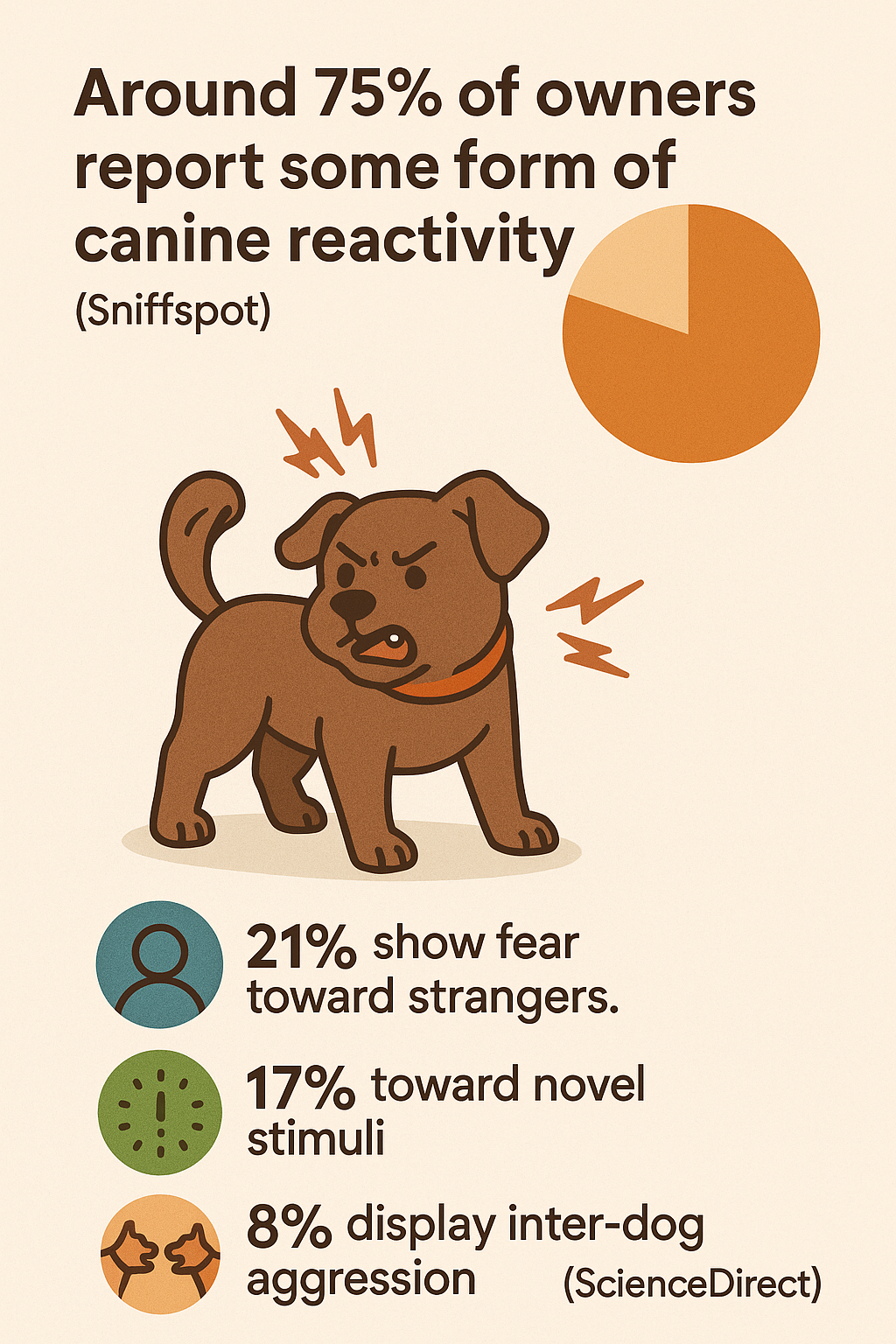
Recent studies highlight how common this really is.
Reactivity isn’t rare—it’s simply misunderstood.
With the right behavioral plan, the prognosis is excellent.
Next Steps for Owners
If your dog struggles with leash frustration or other reactivity, professional guidance accelerates recovery. PJH Dog Training offers science-based, positive-reinforcement behavior modification in Manhattan and the Upper West Side. Schedule a consultation today to start reshaping how your dog experiences the world.
(Continue the series with Dog-Human & Dog-Object Reactivity and The Four Faces of Dog Reactivity to explore every dimension of canine resilience.)
PJH Dog Training, NYC specializes in the assessment and treatment of canine reactivity through its proprietary Reactive Resilience Therapy™ (RRT) framework. For consultations or inquiries, contact pepe.pjhdogtraining@gmail.com or call 347-934-4102.
References
· Tiira, K., Sulkama, S., & Lohi, H. (2016). Prevalence, comorbidity, and behavioural variation in canine anxiety. Journal of Veterinary Behavior: Clinical Applications and Research, 16, 36-44. https://doi.org/10.1016/j.jveb.2016.06.008 (via ScienceDirect) ScienceDirect+2search.lib.utexas.edu+2
· Tiira, K., Sulkama, S., & Lohi, H. (2020). Prevalence, comorbidity, and breed differences in canine anxiety-like traits in Finnish pet dogs (n ≈13,700). Scientific Reports, 10, 2962. https://doi.org/10.1038/s41598-020-59837-z Nature+2ResearchGate+2
· Meyer, I., Forkman, B. (2023). Behaviour problems in dogs — an assessment of prevalence and risk factors based on responses from a representative sample of Danish owners. Applied Animal Behaviour Science, 264, 105803. https://doi.org/10.1016/j.applanim.2023.105803 ScienceDirect+2Consensus+2
· The Dog Aging Project (2024). Health & Life Experience Survey — Behaviour Summary Tables. Retrieved from https://data.dogagingproject.org/HlesBehavior?year=2024 data.dogagingproject.org+1
· Sniffspot. (2023). Sniffspot Research 2023 – Dog Reactivity Survey (n = 4,092) [Infographic/data summary]. Retrieved from https://www.sniffspot.com/blog/dog-reactivity/infographic-2023 SNIFFSPOT+1