Nose & Scent Work Classes on the Upper West Side
Indoor, apartment-friendly scent games that build confidence, focus, and calm — one dog at a time, with no forced interaction. Ideal for reactive, anxious, and overstimulated Manhattan dogs — and led by a trainer who studies how scent work settles the canine nervous system.

What Nose & Scent Work Is
Nose/Scent Work teaches dogs to locate target odors independently using structured scent games and olfactory searches. It builds confidence, focus, and emotional regulation — all without physical strain.
How Do Dogs Smell?
Every scent work class rests on a piece of anatomy we simply do not have. It is worth understanding what your dog is actually doing when their nose goes down — because it explains why the work is so settling for them.
Part one: the nose
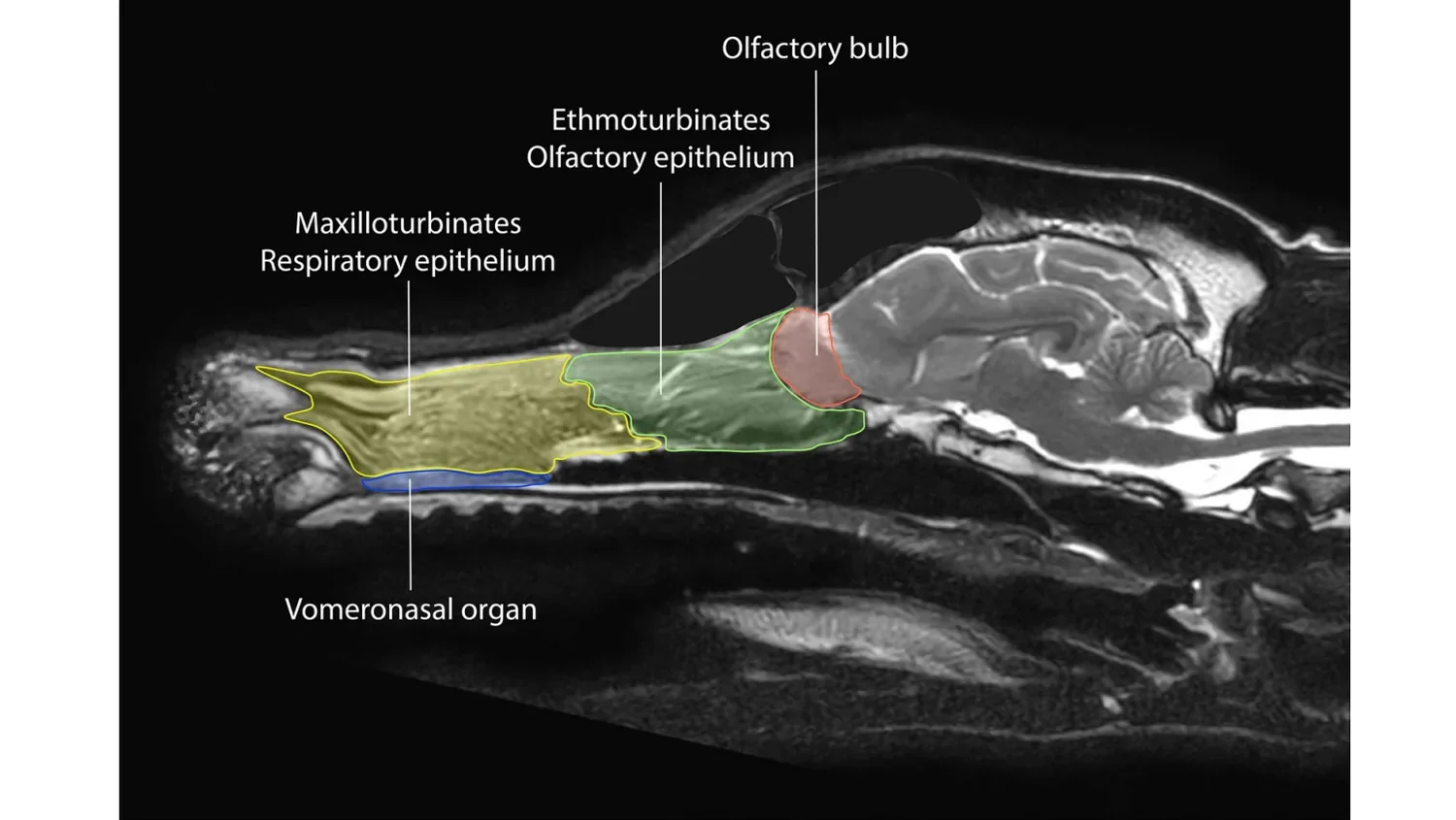
The green region is the part that matters. Those scrolled bones — the ethmoturbinates — are carpeted in olfactory epithelium, and in a shepherd-sized dog they carry somewhere around 220 million olfactory receptor neurons. A person has roughly five million, spread over a patch of tissue a fraction of the size.
The architecture is as important as the number. When your dog sniffs, incoming air splits: most of it goes down the yellow respiratory path to the lungs, while a slice is shunted up into the olfactory recess, where it is held against the sensory tissue instead of being flushed straight back out. Dogs also exhale through the side slits of their nostrils, so the outgoing breath does not blow away the odor plume they are still working on. Sniffing runs at roughly four to seven cycles a second, and each nostril samples slightly separately — which is part of how a dog works out not just what something is, but which way it is.
- 1Nostril. A sniff is not one breath — it is a burst at four to seven cycles a second.
- 2Maxilloturbinates. Most of the air takes this route, warming and filtering on its way to the lungs.
- 3Ethmoturbinates. A slice of each sniff is diverted up into the olfactory recess and held against the sensory tissue.
- 4Olfactory bulb, just past the dashed cribriform plate — the first stop in the brain.
- 5Vomeronasal organ. A separate channel, used for pheromones rather than ordinary smells.
The orange arrow is the part people miss. Spent air leaves through the slits at the sides of the nostrils, directed backwards — so your dog never blows away the scent they are still reading. It is why a tracking dog can keep its nose planted in one spot and go on sampling.
Part two: the brain
The receptor neurons send their axons up through the perforated bone of the cribriform plate and into the olfactory bulb. What happens after that is the genuinely unusual part.
Every other sense your dog has — sight, sound, touch — is routed through the thalamus before it reaches the cortex. Smell is the exception. Odor information arrives at the amygdala, which handles emotional significance, and at the entorhinal cortex and hippocampus, which handle memory, without that intermediate stop. Scent is wired directly into the parts of the brain that decide how something feels and whether it has been encountered before.
A myth worth retiring: you will often read that dogs smell “10,000 to 100,000 times better” than people. That figure has no solid source behind it. Sensitivity varies enormously depending on the compound — for some molecules a dog is staggeringly more sensitive than us, and for others the gap is modest. The interesting part was never the multiplier. It is that a dog’s brain treats odor as a primary way of knowing the world, not as background information.
This is also why scent work settles dogs rather than winding them up. A search is self-paced and dog-led: your dog sets the speed, works a problem they are built to solve, and gets to be right. For a reactive or anxious dog, that combination — low arousal, high success, nose engaged — does more for emotional regulation than another lap of the block. Our reactive dog training program leans on the same mechanism.
Why It Works for Manhattan Dogs
Apartment-friendly enrichment held indoors and designed to help your dog decompress from real urban stressors like crowded sidewalks, elevators, and city noise.
Indoor & apartment-friendly
Held in a calm, controlled indoor space — perfect for rainy days and small-apartment living.
Decompression, not adrenaline
Sniffing lowers arousal and helps city dogs slow down, focus, and recover from overstimulation.
Confidence for sensitive dogs
Independent searching builds problem-solving and self-assurance, especially for shy or anxious dogs.

How a Scent Work Series Progresses
Every series is a little different, but most follow the same arc. Each stage is easy before the next one begins, so dogs finish feeling successful.
1. Learning the search game
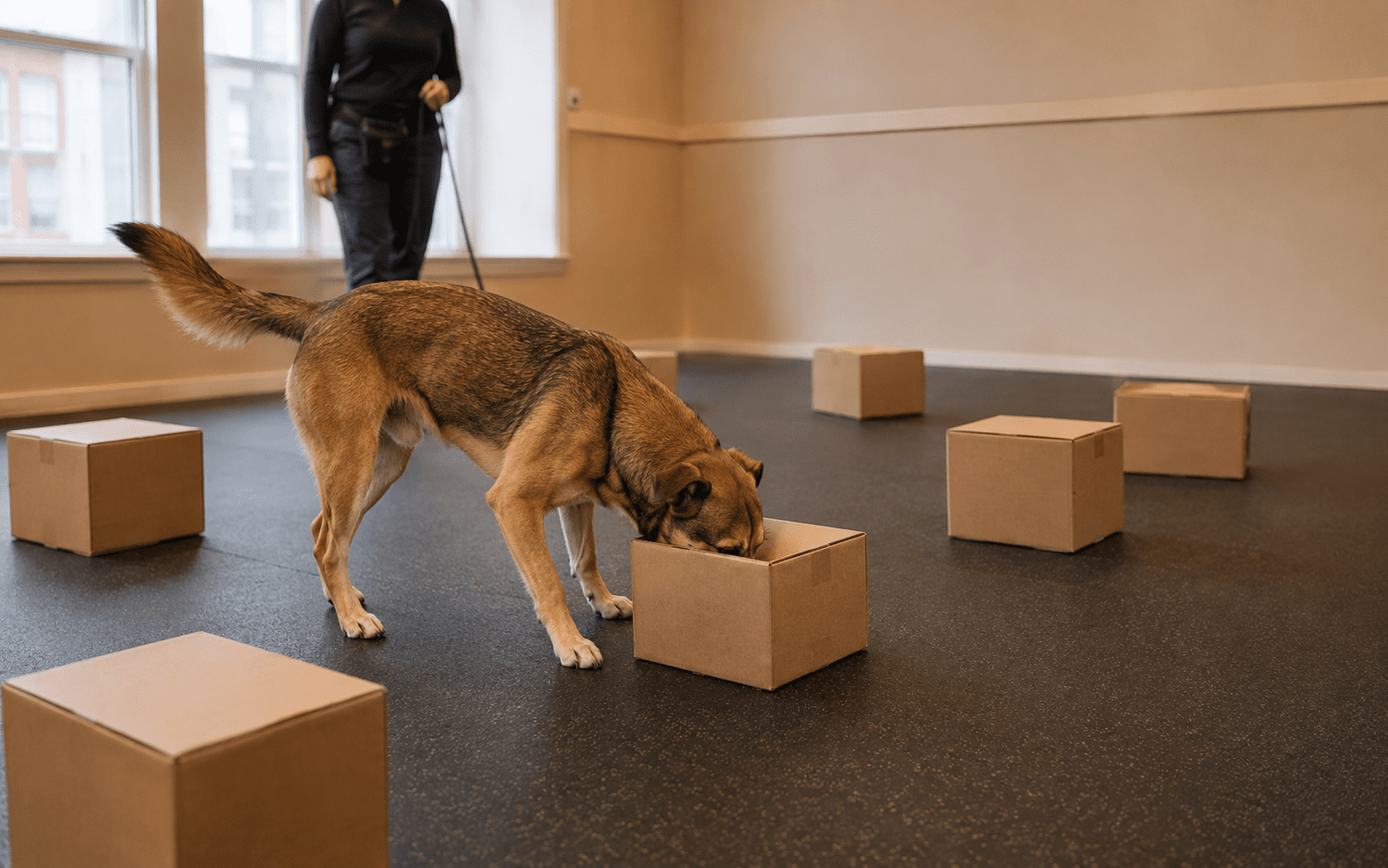
Dogs start with simple searches, such as finding a treat in one of several boxes. The goal is enthusiasm and independence, with no pressure to perform.
2. Introducing a target odor
Next, a target odor is paired with reward, so your dog learns that finding that scent pays off. We move at your dog’s pace.
3. Making the search harder
Hides move to new heights, new areas, and mild distractions, so your dog learns to keep working when things get interesting.
4. Reading your dog
You learn to spot the change in body language when your dog catches an odor, and to stay quiet and let your dog work. That patience carries over to daily walks.
What to Expect in Class
Dogs work one at a time in a calm, structured environment. There is no forced interaction — which makes this ideal for reactive, anxious, and overstimulated dogs. Handlers learn observation and handling skills that translate directly to daily Manhattan life.
One dog at a time
Each team searches individually while others rest — no crowding, no pressure.
No forced interaction
Dogs never have to walk together or pass closely, so leash-reactive dogs can succeed.
Handler skills that carry over
You learn to read body language and support calm focus that helps on every city walk.
Schedule & Enrollment
New Nose Work / Scent Work series — Thursdays 7:30–8:30 p.m., beginning October 22. Held in the Advent Lutheran Church basement, 2504 Broadway at West 93rd Street. This five-class series runs weekly through November 19 and gives dogs an engaging mental workout while building focus, confidence, independent problem-solving, and calm behavior. Enrollment is capped at six dogs, so please register soon if you’d like to join us.
Which Dogs Benefit Most From Scent Work
Scent work suits many dogs, but it is especially useful for the ones who struggle in busy, high-energy settings.
Reactive & leash-reactive dogs
Dogs never walk together or pass closely, so they can work well below their trigger threshold. For more intensive help, see reactive dog training.
Anxious & sensitive dogs
Predictable searches and no forced interaction let a nervous dog build confidence at their own pace.
High-energy adolescents
Mentally demanding work tires a teenage dog in a way another lap around the block does not.
Dogs who struggle in group classes
One dog works at a time, so a dog who gets overwhelmed or pushy around other dogs can still succeed.
Overstimulated city dogs
Sniffing is a natural way for dogs to decompress. Searching teaches them to settle and think after a stimulating day.
Low-impact needs
Searching is gentle on the body. If your dog has a medical condition or mobility limits, check with your vet first.
Nose Work or Agility?
Both are enrichment programs, and many dogs do both. This is how they differ, so you can start with the one that fits.
Nose work
Calm, indoor, one dog at a time, and driven by the nose. A good first step for reactive, anxious, shy, or easily overexcited dogs.
Agility
Active movement, impulse control, and teamwork, with dogs working near each other at a distance. Explore dog agility and indoor agility. Browse every option on training programs.
Scent Games to Play at Home
These games work in a small apartment and take about five minutes. They are good practice between classes and a useful rainy-day outlet.
The cup game
Hide a treat under one of three cups and let your dog find it. Add cups as your dog gets the idea.
Scatter feeding
Scatter part of a meal across a towel or a safe patch of floor and let your dog sniff it out.
Box search
Set out a few cardboard boxes with one treat inside. Praise your dog when they choose the right one.
Rolled towel
Roll treats inside a towel and let your dog unroll it with their nose.
Find it
Toss a treat, then hide a few around one room. Add the cue “find it” and build up the number of hides.
Keep it short
Stop while your dog is still keen. Supervise every game, and use treats and containers that are safe for your dog.
Neuroscience-Based, Force-Free Enrichment
A PhD-level, CPDT-KA certified, 100% force-free program — structured so every dog, including reactive and anxious ones, can work calmly and confidently.
Related Programs
Frequently Asked Questions
Nose/Scent Work is a form of scent training where dogs learn to locate a target odor using their nose. It builds confidence, focus, and independent problem-solving without relying on physical exertion.
Yes. Nose Work and scent training are commonly used interchangeably. Here, Nose/Scent Work refers to recreational scent work focused on enrichment and emotional regulation, not competition.
Less simply than the popular numbers suggest. You will often read that dogs smell “10,000 to 100,000 times better” than people, but that figure has no solid source behind it, and sensitivity varies enormously depending on the compound. For some molecules a dog is staggeringly more sensitive than we are; for others the gap is modest. What is reliably true is the anatomy: a shepherd-sized dog carries roughly 220 million olfactory receptor neurons against about five million in a person, and odor reaches the amygdala and hippocampus without passing through the thalamic relay that every other sense uses. See how dogs smell for the full pathway.
Yes. Classes are structured so dogs work independently with no forced interaction, making this well suited for reactive dogs. Many clients enroll specifically for scent work for reactive dogs in NYC.
Absolutely. Nose/Scent Work helps anxious and overstimulated dogs slow down, focus, and gain confidence through predictable scent games. It is often easier than traditional group classes.
Yes. Dogs are not required to walk together or pass closely, which makes this an excellent option for leash-reactive dogs who struggle in standard training settings.
No prior training is required. This is a beginner scent work class designed for dogs with a wide range of experience levels.
This is recreational scent work. The focus is mental enrichment, confidence building, and calm engagement rather than competition or titles.
Yes. Scent work is mentally demanding, and mental work tires dogs in a calmer, more sustainable way than physical exercise alone — great for decompression and for dogs who are already active.
A series is five weekly one-hour classes with a maximum of six dogs. The next start date and open spots are on the class schedule.
Indoors at Advent Lutheran Church, 2504 Broadway at West 93rd Street on the Upper West Side, so classes run in any weather.
Your dog on a standard leash with a well-fitted harness or collar, plus a pouch of small treats your dog loves. We will confirm anything else in your registration email.
Scent work is calm, one dog at a time, and driven by the nose, which suits reactive, anxious, and easily overexcited dogs. Agility is active movement and teamwork. Many dogs enjoy both; see all training programs.
Because it is low-impact, scent work suits a wide range of ages and fitness levels. If your dog has a medical condition, check with your vet first, and ask us about your dog’s age before you register.
See training prices for the current series rate. Spots are limited, so register early.
Ready to Get Started?
If your dog needs confidence, focus, and decompression in real Manhattan conditions, Nose & Scent Work may be the missing piece.