
Dog Training Manhattan
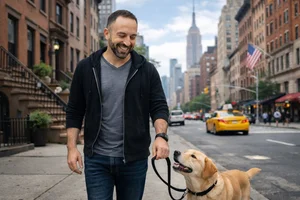
Training a dog here is not training a dog somewhere else with more traffic. Manhattan removes the one thing most training plans quietly depend on — room to move. We train in your building, in your elevator, and on your actual block, with a PhD in behavioral neuroscience and CPDT-KA certification behind the plan.

What makes training a dog in Manhattan different
Almost every training method in circulation was developed somewhere with space. Fenced yards. Quiet streets. A park where you can see another dog coming from eighty feet away and decide what to do about it. The methods are not wrong — they simply assume a resource Manhattan does not supply.
Three features of this island change the work, and they compound.
Stimulus density
A Manhattan dog can pass more dogs, people, vehicles, doors and smells on one ten-minute walk than a suburban dog meets in a week. There is no gradual on-ramp. Your dog is working at volume from the moment the lobby door opens.
You cannot create distance
Most behavior advice rests on moving away from the trigger. On a nine-foot sidewalk with scaffolding on one side and parked cars on the other, that option does not exist. Skills have to work in the space you actually have.
Shared infrastructure
Your dog shares an elevator, a lobby, a hallway and a stairwell with neighbors. Behavior that is merely inconvenient in a house becomes a building-wide problem here — and a source of real social pressure on you.
That combination is why we train on site rather than in a facility. A dog who can hold it together in a quiet training room has learned something, but not the thing you needed. The behavior has to hold at your door, in your elevator, and at your corner at eight in the morning.
What we train here
Every program below is available anywhere in Manhattan. Each has its own page with the full method — this page is about where we work, not a second copy of what we do.
Private in-home training
One customized plan worked through in your apartment and on your block, with homework between visits. The default format for most Manhattan clients.
Reactive & aggressive behavior
Lunging, barking and growling at dogs, people or traffic. Our main specialty, grounded in doctoral research on fear and the nervous system.
Puppy training
Elevator and lobby habituation, house-training without a yard, settling through building noise, and early socialization done carefully on busy sidewalks.
Separation anxiety
Distress when left alone — made harder in an apartment, where barking carries and neighbors notice. Worked in graduated absences from your own door.
Leash skills
Pulling, weaving and stopping dead on crowded sidewalks. Loose-leash walking that survives rush hour, not just an empty street.
Nose work & agility
Scent work and agility classes that give city dogs a real outlet — the thing most Manhattan dogs are short of.
The island is not one training environment
People talk about “Manhattan” as a single place. For a dog it is at least three, and a plan that works in one can fall apart in another.
Uptown
Above 59th Street the parks change everything. Central, Riverside and Morningside Parks give you genuine distance and off-leash hours — which makes uptown the easiest place in Manhattan to rebuild a dog’s comfort around other dogs. The trade-off is dog density: pre-war buildings with small elevators and a lot of residents who all walk at the same times.
Midtown
Midtown is the hardest place on the island for a sound-sensitive or crowd-sensitive dog. Tourist volume, sirens, construction, delivery traffic and almost no green space within a reasonable walk. Plans here lean on indoor work and on routing — choosing when and where you walk, not just how.
Downtown & Lower Manhattan
Tribeca, the Financial District, SoHo and the Village combine narrow colonial-era sidewalks, permanent scaffolding, cobblestones and buildings tall enough to trap sound in the street. Downtown is where “you cannot create distance” stops being a generalisation and becomes the defining constraint of the plan.
- In-home training anywhere in Manhattan at standard rates — no travel surcharge on the island
- Sessions scheduled around your building’s quiet and busy hours, not a fixed class time
- Work happens in the elevator, lobby, hallway and street you actually use
- Evening and weekend availability for full-time schedules
Manhattan neighborhoods we serve
We train across the whole island. These neighborhoods have their own pages, with the local parks, routes and building types we work in.
Upper West Side
Central and Riverside Parks, Broadway, Amsterdam and Columbus, and the pre-war elevator buildings in between. Our home neighborhood.
Upper West Side →Upper East Side
Carl Schurz and the east side of Central Park, doorman buildings, and some of the highest dog density in the city.
Upper East Side →Morningside Heights
Morningside and Riverside Parks, the Columbia campus edge, and the steep cross-streets that shape every walk up here.
Morningside Heights →Hell’s Kitchen
Theatre-district foot traffic, DeWitt Clinton Park, and newer high-rises with long shared corridors.
Hell’s Kitchen →Chelsea
The High Line, Chelsea Piers, gallery-block crowds, and converted loft buildings with freight elevators.
Chelsea →SoHo
Cobblestones, cast-iron lofts, dense retail crowds and some of the narrowest sidewalks in Manhattan.
SoHo →How Manhattan training works
Consultation
We come to you, see the behavior in the place it actually happens, and build the plan around your building and your routes.
The plan
A written plan you keep, with the reasoning included — not a list of commands. You should understand why each step is in the order it is.
Sessions
We work in your apartment, hallway, elevator and block, with homework between visits so the skills transfer into ordinary days.
Support
Between-session contact, and adjustments when your dog or your schedule changes. Behavior work is not linear and the plan should not pretend otherwise.
Rates for consultations, private packages and classes are on the pricing page. Every Manhattan address is charged at standard rates — there is no extended-area travel fee anywhere on the island.
Dog training in Manhattan — FAQs
Do you offer dog training throughout all of Manhattan?
Yes. We train in-home across Manhattan, from Morningside Heights and the Upper West and Upper East Sides through Midtown and Hell’s Kitchen down to Chelsea, SoHo and Lower Manhattan. All of Manhattan is standard service area — there is no extended travel fee anywhere on the island.
Do you train dogs in Lower Manhattan and downtown?
Yes, and downtown is one of the more demanding places to train. Tribeca, the Financial District, SoHo and the Village combine narrow sidewalks, constant construction, heavy foot traffic and tall buildings that trap sound. Training plans built downtown have to assume you often cannot create distance, so we work on skills that function in tight space rather than ones that need room to run.
What makes training a dog in Manhattan different?
Three things: stimulus density, constrained space and shared infrastructure. A Manhattan dog may pass more dogs, people, vehicles and smells in one ten-minute walk than a suburban dog meets in a week. You usually cannot add distance when something appears. And your dog shares an elevator, a lobby and a stairwell with neighbors, so the behavior has to work in spaces you do not control.
How much does a dog trainer in Manhattan cost?
Current rates for consultations, private packages and classes are listed on our pricing page. Manhattan addresses are all charged at standard rates with no travel surcharge.
Is in-home training better than a group class for a Manhattan apartment dog?
It depends on the goal. In-home training is the better fit when the problem happens at home or on your own block — barking at hallway noise, trouble in the elevator, reacting to dogs on your route, house-training, or settling in a small apartment. Group classes are a better fit for social skills and for dogs who need to practice working around other dogs. Many Manhattan clients do both.
Do you work with reactive or aggressive dogs in Manhattan?
Yes. Reactivity and aggression are our main specialty, and the full approach is set out on our reactive dog training page rather than repeated here. Reactive cases are handled in-home anywhere in Manhattan.
Do you train puppies in Manhattan apartment buildings?
Yes. Apartment puppies need a different early plan from suburban puppies: elevator and lobby habituation, house-training without a yard, settling through building noise, and careful early socialization on crowded sidewalks. Puppy work can start as soon as your vet clears your puppy to be out.
How quickly can you start?
Most Manhattan consultations are scheduled within one to two weeks, and sometimes sooner. Book a consultation online and you will get the first available slots for your address.
Related pages
The full approach to lunging, barking and growling — our main area of work.
Read more → ServiceHow the in-home program is structured, session by session.
Read more → CoverageManhattan, Brooklyn and Queens — and the neighborhoods inside each.
Read more → ProgramsEvery program we run, with formats and what each one suits.
Read more → PricingConsultation, private package and class rates, with no travel fees in Manhattan.
Read more → AboutPhD in behavioral neuroscience, CPDT-KA, and why that changes the training.
Read more →Training that works on your block
Tell us your address and what is going wrong. We will come to you, see it where it happens, and build a plan for the Manhattan you actually walk through — not a quieter version of it.