In-Home Puppy Training NYC
Private, one-on-one puppy training in your apartment and on your block — potty training, crate, biting, socialization, leash skills, and real city confidence. Neuroscience-based and force-free — built on the science of how young brains form habits and associations — from the first week home.

Raise a calm, confident city puppy — from week one
The first months at home shape the dog your puppy becomes. In an NYC apartment, that means learning to potty on a schedule, settle through elevator noise and hallway traffic, ride the elevator calmly, meet the world without fear, and keep those needle-sharp teeth off your hands — all before bad habits have a chance to set.
PJH Dog Training delivers private, in-home puppy training across NYC: one-on-one coaching in your apartment, building, and on your block, built around your puppy and your routine. For group skills, we also run puppy socialization classes and puppy obedience classes — many families combine private sessions with a class.
Best fit for:
- New puppies settling into apartment life
- Potty training and crate-comfort struggles
- Hard biting, nipping, and overtired zoomies
- Shy or overwhelmed puppies in the city
- Owners who want a clear plan from day one
Why NYC puppies learn best at home first
Puppies don’t generalize well — a skill learned in a quiet training room often falls apart in the lobby. In-home training teaches your puppy in the exact places life happens, so good habits stick where you actually need them.
- 01 Real environment Your puppy learns potty, settling, and manners in your actual apartment, hallway, and elevator — not a classroom that looks nothing like home.
- 02 Critical windows Socialization and habit-forming happen on a clock. Early in-home work uses those weeks before fear periods and bad patterns set in.
- 03 Whole-household coaching Everyone at home learns the same cues and rules, so your puppy gets consistent messages instead of mixed signals.
- 04 No germ risk Before your puppy is fully vaccinated, in-home training builds skills and confidence safely — without waiting weeks to start.
One-on-one coaching, built around your puppy
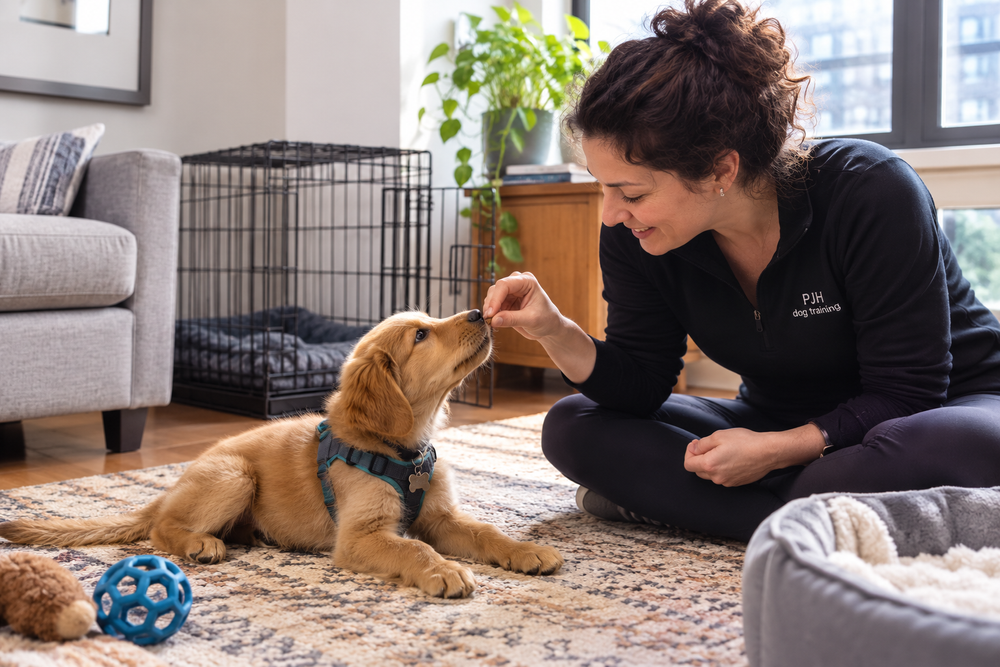
Every session is tailored to your puppy’s stage and your goals: potty schedule, crate comfort, biting, settling, handling, name response, and a first introduction to the leash, the elevator, and the sidewalk.
You leave each session with a clear written plan and homework — so the progress continues between visits, not just during them.
What we build, stage by stage
Puppy raising isn’t one lesson — it’s a sequence. We start with the foundations that make daily life livable, then layer in socialization and obedience as your puppy is ready.
- 01 Foundations Potty training, crate comfort, alone-time, puppy biting, settling, and calm apartment routines — the survival skills, first.
- 02 Socialization & confidence Careful, positive exposure to elevators, sidewalks, noises, people, and other dogs — building a puppy who feels safe in the city.
- 03 Early obedience Name response, recall, leash foundations, sit, down, touch, leave it, drop it, and polite greetings that hold up outdoors.
Private in-home training, puppy classes, or both
Private in-home training is the fastest route to a livable apartment puppy — potty, biting, crate, and settling are easiest to fix where they happen. Group classes add something private work can’t: structured practice around other puppies and shared distractions.
Most NYC families do both. They start private to get the home running smoothly, then add puppy socialization classes for confident social skills and puppy obedience classes for manners that hold up in public. Not sure where to start? A consultation sorts it out.
Common first goals
- Reliable apartment potty schedule
- Calm in the crate and when left alone
- Softer mouth, far less biting
- Settles through hallway & elevator noise
- Confident on the sidewalk and leash
- Friendly, careful greetings
The puppy problems we solve most
PJH Dog Training helps NYC puppy owners get ahead of the behaviors that make the first months hard — using practical, humane, evidence-informed training.
Choose the puppy format that fits your dog and schedule
Start with private in-home foundations, then add group classes, day school, or enrichment as your puppy grows — and build early self-control with a simple home game like cueing fetch with the Premack principle.
Private in-home puppy training
One-on-one coaching in your apartment and neighborhood for potty, biting, crate, settling, and city-life foundations.
View private trainingPuppy socialization classes
Structured, careful socialization with other puppies — confidence, calm observation, and recovery skills, not chaotic play.
View socialization classesPuppy obedience classes
Reliable manners for city life — obedience proofed against crowded sidewalks, busy intersections, and apartment distractions.
View obedience classesDay school
Trainer-led day sessions that build skills while you work, with structured practice and owner transfer.
View day schoolNose work & scent work
Gentle mental enrichment and decompression — confidence-building searching that’s perfect for young dogs.
View nose workReactive dog training
For puppies already showing big feelings about dogs, people, or noise — early help to change the emotional response.
View reactive trainingExplore related PJH Dog Training services
This page is your hub for puppy training in NYC. For deeper, service-specific information, use the links below.
Private In-Home Training
View page → ClassesPuppy Socialization Classes
View page → ClassesPuppy Obedience Training
View page → ServiceDay School
View page → ServiceReactive Dog Training NYC
View page → ServiceNose Work / Scent Work
View page → NeighborhoodDog Training Upper East Side
View page → PricingTraining Prices
View page → LocationsAreas We Serve
View page →Common questions about puppy training in NYC
What age should puppy training start in NYC?
Training can begin the day your puppy comes home, usually around 8 weeks. The early weeks are the most important window for socialization, potty training, crate comfort, and bite-inhibition. Starting early in your own apartment means your puppy learns calm city habits before problems form.
What is the difference between in-home puppy training and puppy classes?
In-home puppy training is private, one-on-one coaching in your apartment and on your block, focused on your puppy’s specific needs — potty training, biting, settling, and the routines of your building. Group classes, such as puppy socialization classes and puppy obedience classes, add structured exposure to other puppies and shared distractions. Many NYC families use both.
Can you help with potty training in an NYC apartment?
Yes. Apartment potty training is one of the most common reasons families book in-home puppy training. Sessions cover a clear schedule, crate and confinement setup, accident prevention, indoor pad-to-outdoor transitions, elevator timing, and reading your puppy’s signals before accidents happen.
How do I stop my puppy from biting?
Puppy biting and mouthing are normal and very trainable. Training focuses on bite-inhibition, appropriate chew outlets, redirection, calm handling, and managing the overtiredness that drives most hard biting. We also coach the whole household so everyone responds the same way.
Is it too late to socialize my puppy?
The prime socialization window is roughly 3 to 14 weeks, but socialization continues for months after. If your puppy is older, training shifts toward confident, careful exposure and recovery skills rather than missing the window entirely. The goal is a puppy who feels safe around city life — not one who has met the most dogs.
Do you use positive reinforcement training?
Yes. PJH Dog Training uses neuroscience-based, force-free, reward-based methods. Puppy training emphasizes confidence, clear communication, emotional safety, and practical skills rather than intimidation, leash corrections, or fear-based handling.
How long does puppy training take?
Most families start with a consultation, then a short package of in-home sessions to build foundations and a daily plan. Puppy raising continues over the following months, so many owners book sessions at key stages — arrival, socialization, adolescence — rather than all at once. Your plan is matched to your puppy and schedule.
Which should I book first — private training or a puppy class?
Most NYC families begin with a private in-home consultation so the home setup, potty schedule, and biting are handled first. From there we recommend the right next step, which may include puppy socialization classes, puppy obedience classes, day school, or continued private sessions.
Book In-Home Puppy Training in NYC
Give your puppy the best possible start — potty training, crate, biting, socialization, leash skills, and real city confidence, taught in your own home from week one.