Pet Anxiety Awareness Month: What Your Dog’s Stress Is Really Trying to Tell You
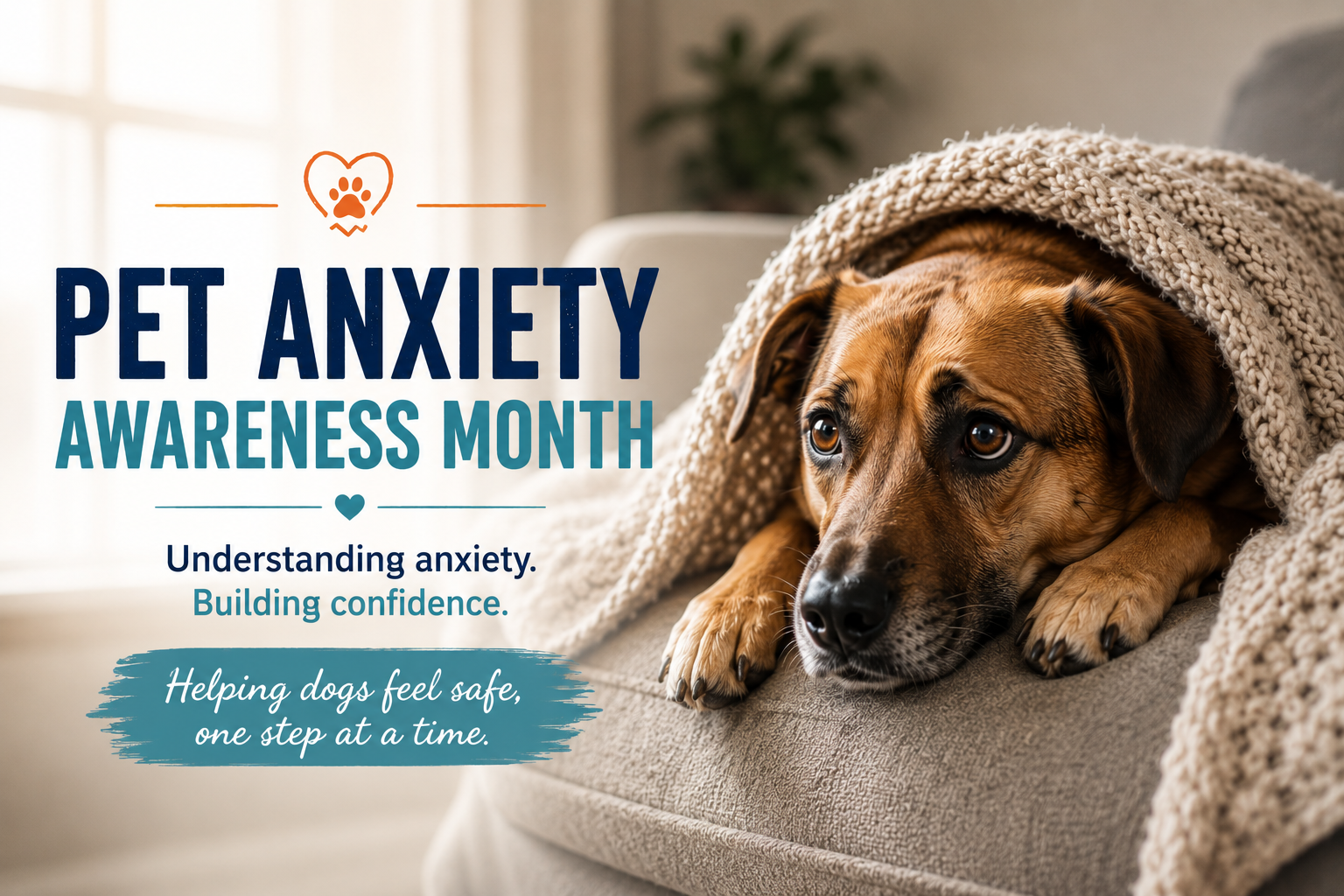
June is Pet Anxiety Awareness Month, which makes it a the perfect time to talk about how dog owners often misunderstand anxiety or misclassify it as : stubbornness, spite, dominance, holding a grude or “bad behavior.” When in fact, more often that not, it is the nervous system saying, I am overwhelmed and I do not know what else to do.
For many dogs, anxiety shows up loud and clear with barking, lunging, whining, pacing, destruction, or panic when left alone. For other dogs, it can be more subtle: freezing, hiding, refusing food, scanning the environment, avoiding touch, or suddenly seeming unable to perform to cues they normally know. The dog who “knows better” may not be choosing to ignore you. Their brain may simply be too stressed to access the behavior you are asking for.
That distinction matters. Once we stop seeing anxiety as a character flaw, we can start treating it as a welfare issue and a training issue.
What Pet Anxiety Can Look Like
Pet anxiety does not always look like trembling in a corner. Dogs are very good at showing stress in ways humans mislabel.
Common signs include:
Barking, whining, or howling when left alone
Pacing, panting, drooling, or restlessness
Destructive behavior, especially around doors, windows, crates, or personal items
House-soiling when alone or after stressful events
Lunging, growling, or barking at dogs, people, scooters, bikes, or city noise
Startling easily or struggling to recover after a trigger
Clinginess, shadowing, or panic when the owner prepares to leave
Refusing treats outside, even when the dog eats well at home
Hyperactivity, jumping, mouthiness, or difficulty settling
Avoidance, freezing, hiding, or shutting down
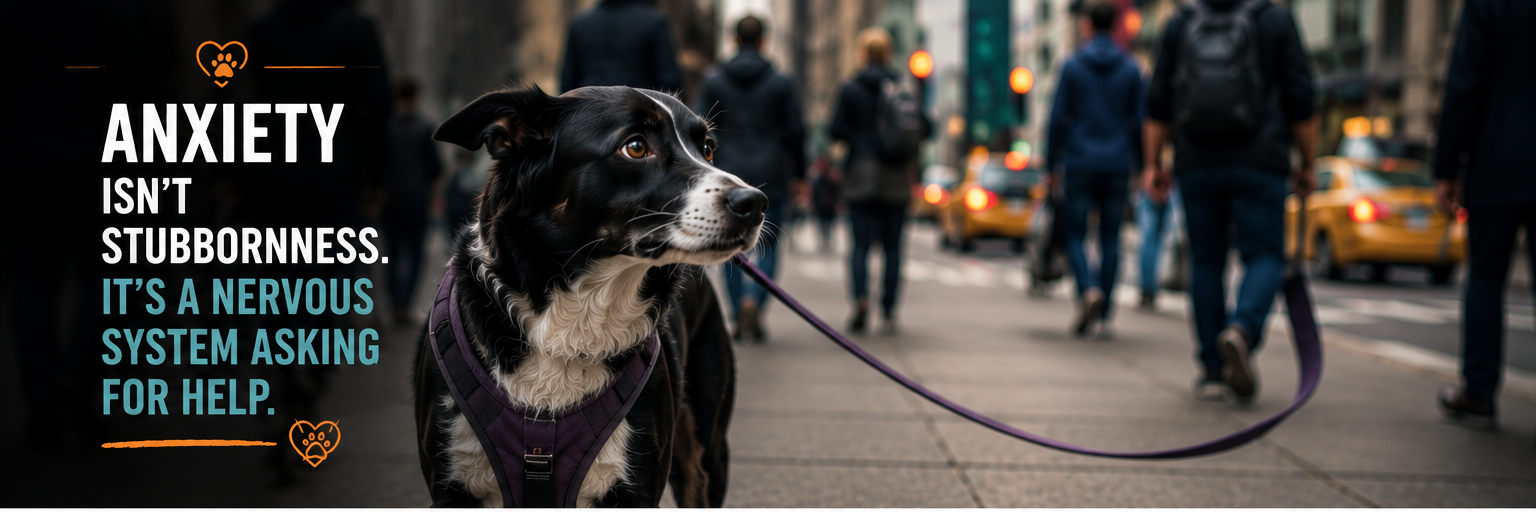
In New York City, anxiety can be especially easy to miss because so many dogs are constantly asked to cope with elevators, lobbies, tight sidewalks, delivery carts, children, other dogs, traffic, construction, sirens, and strangers appearing at close range that we almost accept anxious behaviors as the norm. For some dogs, the city is basically a haunted house with better bagels.
Why Anxiety Changes Behavior
When a dog feels unsafe, the brain prioritizes survival over manners or obedience in some cases. That means the dog may become less responsive, more impulsive, more reactive, or less able to learn.
This is not because the dog is being difficult. Stress changes attention, motivation, memory, and impulse control. A dog who can sit beautifully in the kitchen may not be able to do the same thing in a lobby full of barking dogs and rolling luggage. The cue did not disappear; the bandwidth of the dog’s nervous system has just been exceeded.
This is why punishment often backfires with anxious dogs. If the behavior is driven by fear, adding intimidation, pain, yelling, leash corrections, or threats may suppress the visible behavior temporarily, but it does not make the dog feel safer. It adds fuel to the fire. In many cases, it can make the underlying anxiety worse.
A better goal is not just “stop or suppress the unwanted behavior” but to change how the dog feels, improve coping skills, and teach replacement behaviors the dog can actually perform under pressure. In other words punishing teaches dogs not what to do but only what not to do. It is far more beneficial to teach them what to do instead with positive reinforcement. Imagine yourself trying to take a math exam. Your stressed out because long division has never been your forte and you’d rather glue broken glass shards back together in the back of a bus for a living than carry remainders. Then, add a crazed exam proctor screaming at you about how slow you are and to hurry up, time is ticking — occasionally slapping your hands with a ruler every time you make a mistake or your penmanship isn’t perfect. How will you perform on that exam with that added stress?
Anxiety Is Not Always a Training Problem Alone
Before assuming a dog is “just anxious,” it is worth ruling out medical contributors. Pain, gastrointestinal discomfort, endocrine disease, sensory changes, cognitive decline, allergies, and medication side effects can all affect behavior.
A dog who suddenly becomes reactive, clingy, irritable, noise-sensitive, or house-soiling should be evaluated by a veterinarian. Training is powerful, but it should not be used as a substitute for medical care when health may be part of the picture.
For moderate to severe anxiety, veterinary behavior medication may also be appropriate. Medication is not a moral failure, and it does not replace training. In many cases, it helps the dog’s brain get into a state where training can finally work. Our goal is not to make robots out of our furry friends but to lower the noise in the neural system to allow learning.
How to Help an Anxious Dog
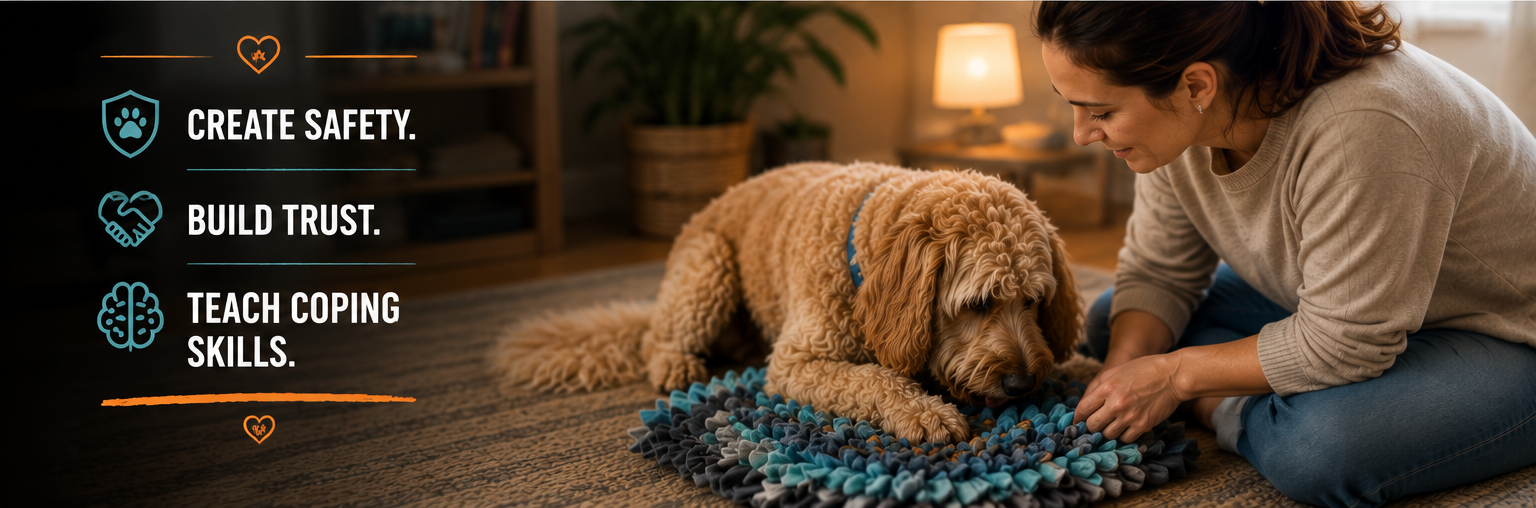
The first step is to reduce unnecessary stress while building skills gradually. That may sound simple, but it is where many training plans either succeed or collapse.
1. Identify the Triggers
Write down what sets your dog off. Is it being left alone? Dogs on leash? Men? Children? Doorbells? Elevators? Fireworks? Uniforms? Handling? Visitors? Food being taken away?
Also note distance, intensity, and recovery time. A dog who can see another dog across the street but panics at ten feet is giving you useful information. We call this threshold in the biz. Distance is not avoidance forever; it is how we create a starting point where learning can happen.
2. Lower the Daily Stress Load
Dogs do not reset instantly after a stressful event. A hard walk full of triggers, or a scary visitor can leave the nervous system more reactive for hours or even longer. You may not even be able to see it outwardly. Dogs are very good at hiding some discomfort.
Managing stress is not cheating. It is humane. Use quieter walking routes, visual barriers, white noise, baby gates, covered windows, food puzzles, decompression walks, and predictable routines. The goal is to stop rehearsing panic while you build better responses.
3. Use Food Strategically
Food is not bribery. Food is information, reinforcement, and emotional leverage. If a dog can eat, think, and reorient toward you around a trigger, that is a useful sign that the dog is still within a trainable range.
If the dog cannot eat, the situation may be too hard. Move farther away, reduce intensity, or give the dog a break. The nervous system has voted.
4. Teach Replacement Behaviors
For anxious dogs, obedience alone is rarely enough. We want functional skills that help the dog cope.
Useful skills include:
Checking in with the handler
Moving behind or beside the owner
Turning away from triggers
Going to a mat
Settling after excitement
Relaxing in a crate or safe area
Following a predictable departure routine
Sniffing on cue
Taking food calmly around mild distractions
These behaviors should be taught first in easy environments, then gradually practiced around real-life distractions.
5. Avoid Flooding
Flooding means exposing the dog to something scary at full intensity and hoping they “get over it.” Sometimes the dog stops reacting because they have learned the situation is inescapable. That is not confidence. That is shutdown wearing a cheap disguise.
Good behavior modification works below threshold whenever possible. The dog should notice the trigger but still be able to eat, think, move, and recover.
6. Support the Dog During High-Risk Events
Fireworks, thunderstorms, moving apartments, new babies, travel, surgery recovery, visitors, and schedule changes can all worsen anxiety.
Plan ahead. Create a safe space, use sound masking, close blinds, provide calming enrichment, avoid unnecessary exposure, and ask your veterinarian about medication or supplements when appropriate. Waiting until the dog is already panicking is like putting on sunscreen after the lobster phase.
When to Get Professional Help
You should seek help from a qualified trainer, behavior consultant, or veterinarian if your dog:
Panics when left alone
Barks, lunges, growls, or snaps at people or dogs
Has bitten or attempted to bite
Cannot recover after triggers
Is injuring themselves trying to escape
Has sudden behavior changes
Cannot relax at home
Seems fearful in everyday environments
Is getting worse despite your best efforts
Anxiety is easier to treat when it is addressed early. Waiting often allows the dog to rehearse the behavior until it becomes stronger, faster, and more automatic.
The Big Picture
Pet Anxiety Awareness Month is not just about naming the problem. It is about changing how we respond to it.
Anxious dogs are not giving us a hard time. They are having a hard time. When we recognize the signs, reduce pressure, protect the dog’s sense of safety, and train at a pace the dog can handle, we give them a real chance to improve.
The goal is not to create a robot dog who never reacts. The goal is a dog who feels safer, recovers faster, and has better tools for living in a very human world.
If your dog struggles with anxiety, reactivity, separation distress, or city-life overwhelm, PJH Dog Training in NYC can help you build a practical, humane training plan tailored to your dog’s nervous system, your home, and your real life. Virtual support is also available.